Everyone has a different hobby. In the Williams family, we read books — and 2025 was no different. Candidly, my book list was much shorter this year. An increase in work responsibilities left me with less time to read.
But I still found time to read 19 books, and I’d like to share them with you — along with a brief description and quote. I share these in case any of these books sound interesting to you. But first, I want to highlight a few books I enjoyed most…
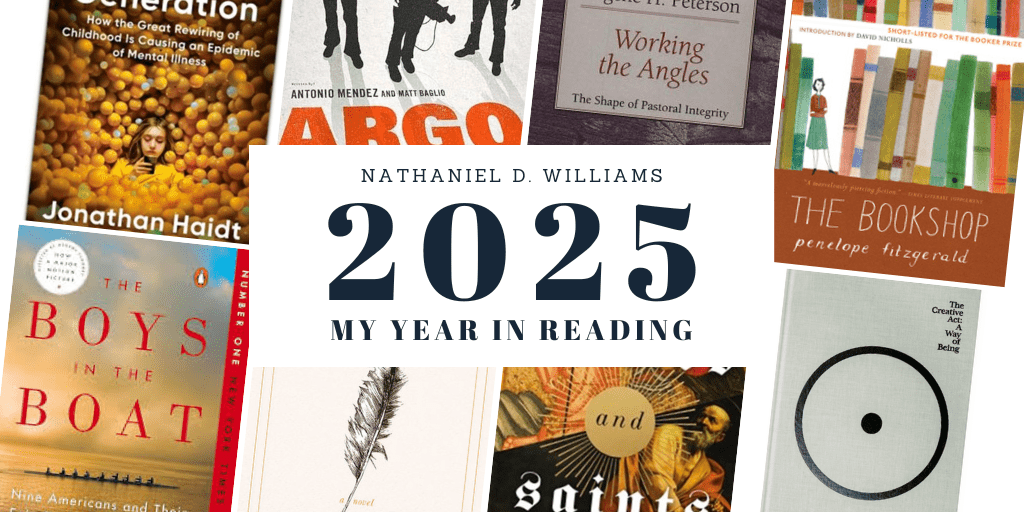
THE AWARDS
Nathaniel’s Book of the Year
The Boys in the Boat: Nine Americans and Their Epic Quest for Gold at the 1936 Berlin Olympics
by Daniel James Brown (Penguin Books, 2014)
The Boys in the Boat is remarkable for the story it tells; the rise of young Joe Rantz and his colleagues from a rag-tag, blue-collar band of rowers into world champions is the stuff of legend. It’s the kind of story that must be read to be believed — all the way down to the photo finish victory against the Germans with Hitler in attendance. But the book is also remarkable for how Brown tells this story. It’s a gripping read. Brown gets you inside the rowers’ minds and makes you feel like you’re in the boat with them: “All were merged into one smoothly working machine; they were, in fact, a poem of motion, a symphony of swinging blades.”
Some quotes to give you a flavor of the book:
- “Standing there, watching them, it occurred to me that when Hitler watched Joe and the boys fight their way back from the rear of the field to sweep ahead of Italy and Germany seventy-five years ago, he saw, but did not recognize, heralds of his doom. He could not have known that one day hundreds of thousands of boys just like them, boys who shared their essential natures—decent and unassuming, not privileged or favored by anything in particular, just loyal, committed, and perseverant—would return to Germany dressed in olive drab, hunting him down.”
Chills. I can’t recommend The Boys in the Boat enough.
The Most Surprising Book
Theo of Golden
by Allen Levi (2023)
I’d heard a growing amount of chatter about Theo of Golden, so I decided to read it for myself. I was skeptical, as the self-published landscape is usually a graveyard of unnecessary stories and half-baked ideas. But Theo of Golden stands apart as a beautiful meditation on grace, the overflow of a life marked by the grace of Jesus.
While it took me a few chapters to get into the book, eventually the book captured my mind and my heart. The main character, Theo, truly is a remarkable, compelling character. He sees beauty in all of the broken people around him, and he loves them until they see it for themselves. In a world of cynicism and despair, Theo of Golden shines as a beacon of love, dignity, and hope. The book could veer into sentimentality, but Theo’s character prevents it from doing so.
I don’t want to give too much away, so do yourself a favor and read this book for yourself.
“Living with sadness, accepting it, is easier than trying to pretend it isn’t there. It is another of life’s great mysteries that sadness and joy can coexist so compatibly with one another. In fact, I wonder if, on this side of heaven, either one can be complete without the other.”
The Book Every Parent Should Read
The Anxious Generation: How The Great Rewiring of Childhood is Causing an Epidemic of Mental Illness
by Jonathan Haidt (2024)
The Anxious Generation has been at the top of many people’s reading lists for good reason. Haidt tracks the decline of a play-based childhood and the corresponding rise of a phone-based childhood, and he highlights the horrific effects this change is having on children and youth. Parents are afraid of the wrong things, Haidt argues. Parents are overly concerned about their kids being unsupervised outside, but not concerned enough about their digital activity and influences.
What I appreciate most about this book is that Haidt has not merely written a jeremiad, lamenting the woes of modern culture while waxing nostalgic for some bygone glory days. Rather, Haidt supports his argument with data and research. He also charts a path forward with specific steps parents and policymakers can make to change for the future.
I also find it interesting that Haidt, who claims no religion, sees the value of faith and religious communities. It’s often in the darkest times that the light of the gospel shines brightest, and Haidt’s observations testify to this truth:
“There is a hole, an emptiness in us all, that we strive to fill. If it doesn’t get filled with something noble and elevated, modern society will quickly pump it full of garbage. That has been true since the beginning of the age of mass media, but the garbage pump got 100 times more powerful in the 2010s. It matters what we expose ourselves to.“
The Most Frustratingly Beautiful Book
The Creative Act: A Way of Being
by Rick Rubin (Penguin, 2023)
The Creative Act is a frustratingly beautiful meditation on the creative process. Rick Rubin is one of the most respected music producers, and each word is crafted with intentionality. In many ways, the book itself is the exemplar of Rubin’s careful, intentional, beautiful approach to art. So reading this book is a joy; it is indeed beautiful.
Yet frustratingly so. Rubin clearly sees some degree of spirituality and transcendence reflected in the creative process; as such, so many of his reflections resonate with a Christian worldview. “The universe holds a sense of harmony, a beautifully deep, interdependent system,” he says. But he can’t see the truth right in front of him: that we are creative beings because we were made in the image of a loving Creator God.
So read this book. Enjoy this book. Be shaped and molded by it. But read it with the greater truth of Scripture in mind. It is beautiful, but frustratingly so.
The Best Book for My Soul
Working the Angles: The Shape of Pastoral Integrity
by Eugene Peterson (Eerdmans, 1989)
Eugene Peterson has served as something of a literary pastoral mentor for me, and I’m slowly working my way through his books. Like all of Peterson’s books, I may not agree with every word he writes. But he always challenges me to know the Lord more deeply, think more carefully, pray more consistently, and love others more sacrificially.
There is no cotton candy in a Eugene Peterson book; only meat and potatoes. And that is the case with Working the Angles. Peterson argues that pastoral ministry entails three primary responsibilities: praying, reading Scripture, and giving spiritual direction. Along the way, he builds the case for a prayer-filled, others-focused, Scripture-saturated gospel ministry. Here’s one beautiful quote from the book: “The moment we begin to see others in terms of what they can do rather than who they are, we mutilate humanity and violate community.“
THE REST OF THE 2025 READING LIST
Fiction
The Bookshop
by Penelope Fitzgerald (1978)
The Bookshop is a slow-moving tragedy. A woman has a dream of opening a bookstore in a small seaside village. In the end, her dreams are crushed by a petty powerful woman with the right connections. Most concerning are all the people who look the other way, unbothered or too busy to stop the injustice happening before them. “She had a kind heart, though that is not of much use when it comes to the matter of self-preservation.”
(Fun fact: My third child “accidentally” bought this book for me on Kindle a few years ago. I’m still not quite sure how he did it! But after a few years, I finally read it. So, thank you, son, for that impromptu purchase!)
The Trumpet of the Swan
by E. B. White (1970)
My wife and the kids love this book, so I decided to try it for myself. It’s a beautiful portrayal of a character who overcomes his own disabilities to live a full, meaningful life. “The world is full of talkers, but it is rare to find anyone who listens. And I assure you that you can pick up more information when you are listening than when you are talking.“
My Side of the Mountain
by Jean Craighead George (1959)
One of my favorite novels about a boy named Sam making out a life for himself in the wilderness. George has clearly done her research, as she includes interesting details about the flora and fauna of the wilderness and how Sam uses them for his survival. But the real star of the book is Sam’s pet Falcon, Frightful. Here’s an excerpt from the book: “Fortunately, the sun has a wonderfully glorious habit of rising every morning. When the sky lightened, when the birds awoke, I knew I would never again see anything so splendid as the round red sun coming up over the earth.”
Treasure Island
by Robert Louis Stevenson (1883)
My first time reading this classic novel, and I was inspired to do so after watching the Muppets’ adaptation. The slow reveal of Long John Silver really is compelling. “We must go on, because we can’t turn back.”
Harry Potter and the Chamber of Secrets
by J. K. Rowling (Scholastic, 1998)
Each year we re-read one of the Harry Potter books. This year, Chamber of Secrets was the selection. We were latecomers to the Potter books, as I only began reading them a decade or so ago. But I still find them soothing and nostalgic. Of note: Tom Riddle’s diary certainly reads differently in a ChatGPT world. As Mr. Weasley says, “Never trust anything that can think for itself if you can’t see where it keeps its brain.“
The Importance of Being Earnest
by Oscar Wilde (1895)
I acted in this play in high school, and I still return to it every few years to read it for fun. Wilde’s work has a razor-sharp satirical edge that remains humorous more than 130 years later. This quote feels appropriate for a list like this: “Oh! it is absurd to have a hard-and-fast rule about what one should read and what one shouldn’t. More than half of modern culture depends on what one shouldn’t read.”
Leadership & Marketing
Shut Up and Listen!: Hard Business Truths That Will Help You Succeed
Tilman Fertitta (Harper Collins, 2019)
Fertitta is a brash, risk-taking entrepreneur and business owner, and this book embodies his personality — with all its strengths and weaknesses. Not all of his business truths are applicable to me, but I did resonate with this line: “I don’t fear anything. I worry about everything.” To “worry about everything” is his way of describing focusing on the details. In his estimation, there’s a difference between actual “fear” and this kind of emphasis on the “details.” I found this helpful in my own leadership and management of others on my team.
Payoff: The Hidden Logic That Shapes Our Motivations
by Dan Ariely (Simon & Schuster / TED, 2016)
Ariely explores the nature of motivation and how it affects business. One of the key takeaways is that people’s why matters more than the what. Practically, this means motivating people with individualized strategies — one-on-one meetings, written encouragements, and specific plans. “Acknowledgment is a kind of human magic—a small human connection, a gift from one person to another that translates into a much larger, more meaningful outcome.”
The Five Dysfunctions of a Team: A Leadership Fable
by Patrick Lencioni (Jossey-Bass, 2002)
I’ve read several of these leadership books which use a fable to deliver the main points; Lencioni’s book may be among the best. Lencioni structures his book around the dysfunctions; here are the corresponding features of functional teams:
- Trust one another
- Engage in unfiltered conflict about ideas
- Commit to decisions and plans of action
- Hold one another accountable to achieve plans
- Focus on achievement of collective results
Start with Why: How Great Leaders Inspire Everyone to Take Action
by Simon Sinek (Portfolio, 2009)
“People don’t buy what you do; they buy why you do it.” Sinek is a go-to voice in marketing, and this book highlights his most fundamental leadership lesson. Some of his specific observations feel dated today, but his key points are timeless:
- “Energy motivates, but charisma inspires.”
- Clarity needs a megaphone.
- As a company grows, the leader must personify the why. They aren’t the megaphone; they must be the message spoken through it.
- “Finding why is a process of discovery not invention.”
Christian Nonfiction
Building a Great Commission Seminary: Different By Design
by Keith Harper, Josh Pruitt, and Faith Steele (2025)
The late Dr. Harper and his co-authors, Pruitt and Steele, tell the story of Southeastern Seminary in honor of its 75th anniversary. The book pulls no punches; it is unflinchingly honest about the main characters in Southeastern’s history. But it’s also fair — simply seeking to tell the story, warts and all. (Disclaimer: Southeastern’s Communications office helped edit, design, and publish the book. So I’ve read this book more than most!)
Bullies and Saints: An Honest Look at the Good and Evil of Christian History
by John Dickson (Zondervan, 2024)
Dickson tells the good and bad from church history. I found the book to be both challenging and encouraging; we can learn much from those who modeled the faith well for us, and we can learn from those who failed in this regard. But he’s quick to highlight that many modern critics overstate their case against Christianity. “Christ wrote a beautiful tune, which the church has often performed well, and often badly. But the melody was never completely drowned out. Sometimes it became a symphony.“
Nonfiction
Argo: How the CIA & Hollywood Pulled Off the Most Audacious Rescue in History
by Antonio J. Méndez with Matt Baglio (Penguin, 2012)
Much like The Boys in the Boat, Argo is a story that seems too wild to be true. But it is. In essence, CIA agents use connections in Hollywood to sneak runaway hostages out of Iran. It’s a wild, twisting story that deserves to be read. In the end, though, it’s a lesson in preparedness and logistics. “One of the main lessons I had learned is that exfiltrations are almost ninety percent logistics – just making sure everything is lined up as it needs to be.”
Revenge of the Tipping Point: Overstories, Superspreaders, and the Rise of Social Engineering
by Malcolm Gladwell (Little, Brown and Company, 2024)
Malcolm Gladwell has become one of my favorite authors in recent years, and his book The Tipping Point is perhaps his best. This book functions as a sequel, highlighting some lessons and truths he’s learned since the publication of the first book. The big takeaway: Grand narratives, or what he calls “overstories,” matter. From a Christian perspective, we know this to be true as well. “I always like to quote this line from Scottish writer Andrew Fletcher. ‘If I can write the songs of a nation, I don’t care who writes their laws.” We need to pay more attention to the songs we’re singing.‘”
 Nathaniel D. Williams