2025: A Year in Reading

Everyone has a different hobby. In the Williams family, we read books — and 2025 was no different. Candidly, my book list was much shorter this year. An increase in work responsibilities left me with less time to read.

But I still found time to read 19 books, and I’d like to share them with you — along with a brief description and quote. I share these in case any of these books sound interesting to you. But first, I want to highlight a few books I enjoyed most…
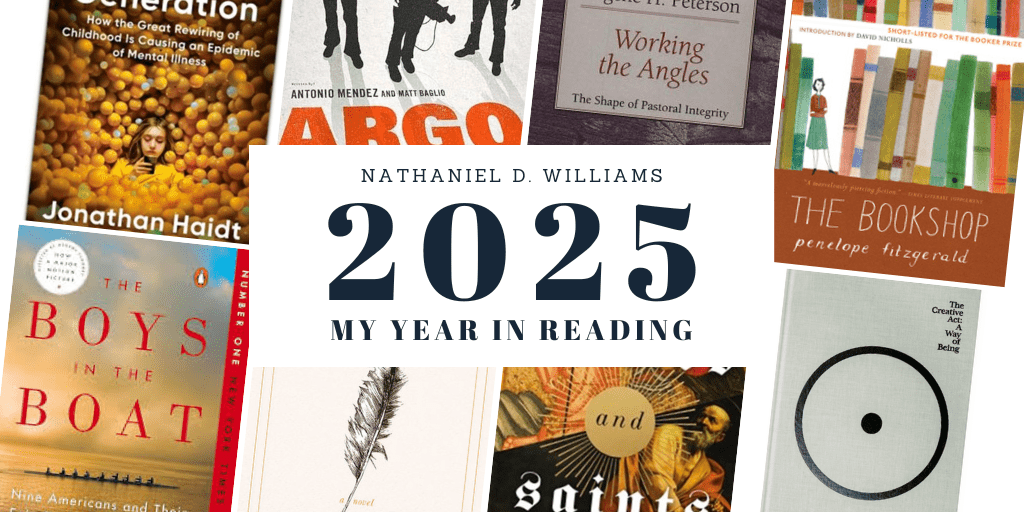
THE AWARDS

Nathaniel’s Book of the Year

The Boys in the Boat: Nine Americans and Their Epic Quest for Gold at the 1936 Berlin Olympics
by Daniel James Brown (Penguin Books, 2014)

The Boys in the Boat is remarkable for the story it tells; the rise of young Joe Rantz and his colleagues from a rag-tag, blue-collar band of rowers into world champions is the stuff of legend. It’s the kind of story that must be read to be believed — all the way down to the photo finish victory against the Germans with Hitler in attendance. But the book is also remarkable for how Brown tells this story. It’s a gripping read. Brown gets you inside the rowers’ minds and makes you feel like you’re in the boat with them: “All were merged into one smoothly working machine; they were, in fact, a poem of motion, a symphony of swinging blades.

Some quotes to give you a flavor of the book:

  • Standing there, watching them, it occurred to me that when Hitler watched Joe and the boys fight their way back from the rear of the field to sweep ahead of Italy and Germany seventy-five years ago, he saw, but did not recognize, heralds of his doom. He could not have known that one day hundreds of thousands of boys just like them, boys who shared their essential natures—decent and unassuming, not privileged or favored by anything in particular, just loyal, committed, and perseverant—would return to Germany dressed in olive drab, hunting him down.”

Chills. I can’t recommend The Boys in the Boat enough.

The Most Surprising Book

Theo of Golden
by Allen Levi (2023)

I’d heard a growing amount of chatter about Theo of Golden, so I decided to read it for myself. I was skeptical, as the self-published landscape is usually a graveyard of unnecessary stories and half-baked ideas. But Theo of Golden stands apart as a beautiful meditation on grace, the overflow of a life marked by the grace of Jesus.

While it took me a few chapters to get into the book, eventually the book captured my mind and my heart. The main character, Theo, truly is a remarkable, compelling character. He sees beauty in all of the broken people around him, and he loves them until they see it for themselves. In a world of cynicism and despair, Theo of Golden shines as a beacon of love, dignity, and hope. The book could veer into sentimentality, but Theo’s character prevents it from doing so.

I don’t want to give too much away, so do yourself a favor and read this book for yourself.

Living with sadness, accepting it, is easier than trying to pretend it isn’t there. It is another of life’s great mysteries that sadness and joy can coexist so compatibly with one another. In fact, I wonder if, on this side of heaven, either one can be complete without the other.”

The Book Every Parent Should Read

The Anxious Generation: How The Great Rewiring of Childhood is Causing an Epidemic of Mental Illness
by Jonathan Haidt (2024)

The Anxious Generation has been at the top of many people’s reading lists for good reason. Haidt tracks the decline of a play-based childhood and the corresponding rise of a phone-based childhood, and he highlights the horrific effects this change is having on children and youth. Parents are afraid of the wrong things, Haidt argues. Parents are overly concerned about their kids being unsupervised outside, but not concerned enough about their digital activity and influences.

What I appreciate most about this book is that Haidt has not merely written a jeremiad, lamenting the woes of modern culture while waxing nostalgic for some bygone glory days. Rather, Haidt supports his argument with data and research. He also charts a path forward with specific steps parents and policymakers can make to change for the future.

I also find it interesting that Haidt, who claims no religion, sees the value of faith and religious communities. It’s often in the darkest times that the light of the gospel shines brightest, and Haidt’s observations testify to this truth:

There is a hole, an emptiness in us all, that we strive to fill. If it doesn’t get filled with something noble and elevated, modern society will quickly pump it full of garbage. That has been true since the beginning of the age of mass media, but the garbage pump got 100 times more powerful in the 2010s. It matters what we expose ourselves to.

The Most Frustratingly Beautiful Book

The Creative Act: A Way of Being
by Rick Rubin (Penguin, 2023)

The Creative Act is a frustratingly beautiful meditation on the creative process. Rick Rubin is one of the most respected music producers, and each word is crafted with intentionality. In many ways, the book itself is the exemplar of Rubin’s careful, intentional, beautiful approach to art. So reading this book is a joy; it is indeed beautiful.

Yet frustratingly so. Rubin clearly sees some degree of spirituality and transcendence reflected in the creative process; as such, so many of his reflections resonate with a Christian worldview. “The universe holds a sense of harmony, a beautifully deep, interdependent system,” he says. But he can’t see the truth right in front of him: that we are creative beings because we were made in the image of a loving Creator God.

So read this book. Enjoy this book. Be shaped and molded by it. But read it with the greater truth of Scripture in mind. It is beautiful, but frustratingly so.

The Best Book for My Soul

Working the Angles: The Shape of Pastoral Integrity
by Eugene Peterson (Eerdmans, 1989)

Eugene Peterson has served as something of a literary pastoral mentor for me, and I’m slowly working my way through his books. Like all of Peterson’s books, I may not agree with every word he writes. But he always challenges me to know the Lord more deeply, think more carefully, pray more consistently, and love others more sacrificially.

There is no cotton candy in a Eugene Peterson book; only meat and potatoes. And that is the case with Working the Angles. Peterson argues that pastoral ministry entails three primary responsibilities: praying, reading Scripture, and giving spiritual direction. Along the way, he builds the case for a prayer-filled, others-focused, Scripture-saturated gospel ministry. Here’s one beautiful quote from the book: “The moment we begin to see others in terms of what they can do rather than who they are, we mutilate humanity and violate community.

THE REST OF THE 2025 READING LIST

Fiction

The Bookshop 
by Penelope Fitzgerald (1978)

The Bookshop is a slow-moving tragedy. A woman has a dream of opening a bookstore in a small seaside village. In the end, her dreams are crushed by a petty powerful woman with the right connections. Most concerning are all the people who look the other way, unbothered or too busy to stop the injustice happening before them. “She had a kind heart, though that is not of much use when it comes to the matter of self-preservation.”

(Fun fact: My third child “accidentally” bought this book for me on Kindle a few years ago. I’m still not quite sure how he did it! But after a few years, I finally read it. So, thank you, son, for that impromptu purchase!)

The Trumpet of the Swan
by E. B. White (1970)

My wife and the kids love this book, so I decided to try it for myself. It’s a beautiful portrayal of a character who overcomes his own disabilities to live a full, meaningful life. “The world is full of talkers, but it is rare to find anyone who listens. And I assure you that you can pick up more information when you are listening than when you are talking.

My Side of the Mountain
by Jean Craighead George (1959)

One of my favorite novels about a boy named Sam making out a life for himself in the wilderness. George has clearly done her research, as she includes interesting details about the flora and fauna of the wilderness and how Sam uses them for his survival. But the real star of the book is Sam’s pet Falcon, Frightful. Here’s an excerpt from the book: “Fortunately, the sun has a wonderfully glorious habit of rising every morning. When the sky lightened, when the birds awoke, I knew I would never again see anything so splendid as the round red sun coming up over the earth.”

Treasure Island
by Robert Louis Stevenson (1883)

My first time reading this classic novel, and I was inspired to do so after watching the Muppets’ adaptation. The slow reveal of Long John Silver really is compelling. “We must go on, because we can’t turn back.”

Harry Potter and the Chamber of Secrets
by J. K. Rowling (Scholastic, 1998)

Each year we re-read one of the Harry Potter books. This year, Chamber of Secrets was the selection. We were latecomers to the Potter books, as I only began reading them a decade or so ago. But I still find them soothing and nostalgic. Of note: Tom Riddle’s diary certainly reads differently in a ChatGPT world. As Mr. Weasley says, “Never trust anything that can think for itself if you can’t see where it keeps its brain.

The Importance of Being Earnest
by Oscar Wilde (1895)

I acted in this play in high school, and I still return to it every few years to read it for fun. Wilde’s work has a razor-sharp satirical edge that remains humorous more than 130 years later. This quote feels appropriate for a list like this: “Oh! it is absurd to have a hard-and-fast rule about what one should read and what one shouldn’t. More than half of modern culture depends on what one shouldn’t read.”

Leadership & Marketing

Shut Up and Listen!: Hard Business Truths That Will Help You Succeed
Tilman Fertitta (Harper Collins, 2019)

Fertitta is a brash, risk-taking entrepreneur and business owner, and this book embodies his personality — with all its strengths and weaknesses. Not all of his business truths are applicable to me, but I did resonate with this line: “I don’t fear anything. I worry about everything.” To “worry about everything” is his way of describing focusing on the details. In his estimation, there’s a difference between actual “fear” and this kind of emphasis on the “details.” I found this helpful in my own leadership and management of others on my team.

Payoff: The Hidden Logic That Shapes Our Motivations
by Dan Ariely (Simon & Schuster / TED, 2016)

Ariely explores the nature of motivation and how it affects business. One of the key takeaways is that people’s why matters more than the what. Practically, this means motivating people with individualized strategies — one-on-one meetings, written encouragements, and specific plans. “Acknowledgment is a kind of human magic—a small human connection, a gift from one person to another that translates into a much larger, more meaningful outcome.”

The Five Dysfunctions of a Team: A Leadership Fable
by Patrick Lencioni (Jossey-Bass, 2002)

I’ve read several of these leadership books which use a fable to deliver the main points; Lencioni’s book may be among the best. Lencioni structures his book around the dysfunctions; here are the corresponding features of functional teams:

  1. Trust one another
  2. Engage in unfiltered conflict about ideas
  3. Commit to decisions and plans of action
  4. Hold one another accountable to achieve plans
  5. Focus on achievement of collective results

Start with Why: How Great Leaders Inspire Everyone to Take Action
by Simon Sinek (Portfolio, 2009)

People don’t buy what you do; they buy why you do it.” Sinek is a go-to voice in marketing, and this book highlights his most fundamental leadership lesson. Some of his specific observations feel dated today, but his key points are timeless:

  • “Energy motivates, but charisma inspires.”
  • Clarity needs a megaphone.
  • As a company grows, the leader must personify the why. They aren’t the megaphone; they must be the message spoken through it.
  • “Finding why is a process of discovery not invention.”

Christian Nonfiction

Building a Great Commission Seminary: Different By Design
by Keith Harper, Josh Pruitt, and Faith Steele (2025)

The late Dr. Harper and his co-authors, Pruitt and Steele, tell the story of Southeastern Seminary in honor of its 75th anniversary. The book pulls no punches; it is unflinchingly honest about the main characters in Southeastern’s history. But it’s also fair — simply seeking to tell the story, warts and all. (Disclaimer: Southeastern’s Communications office helped edit, design, and publish the book. So I’ve read this book more than most!)

Bullies and Saints: An Honest Look at the Good and Evil of Christian History
by John Dickson (Zondervan, 2024)

Dickson tells the good and bad from church history. I found the book to be both challenging and encouraging; we can learn much from those who modeled the faith well for us, and we can learn from those who failed in this regard. But he’s quick to highlight that many modern critics overstate their case against Christianity. “Christ wrote a beautiful tune, which the church has often performed well, and often badly. But the melody was never completely drowned out. Sometimes it became a symphony.

Nonfiction

Argo: How the CIA & Hollywood Pulled Off the Most Audacious Rescue in History
by Antonio J. Méndez with Matt Baglio (Penguin, 2012)

Much like The Boys in the Boat, Argo is a story that seems too wild to be true. But it is. In essence, CIA agents use connections in Hollywood to sneak runaway hostages out of Iran. It’s a wild, twisting story that deserves to be read. In the end, though, it’s a lesson in preparedness and logistics. “One of the main lessons I had learned is that exfiltrations are almost ninety percent logistics – just making sure everything is lined up as it needs to be.”

Revenge of the Tipping Point: Overstories, Superspreaders, and the Rise of Social Engineering
by Malcolm Gladwell (Little, Brown and Company, 2024)

Malcolm Gladwell has become one of my favorite authors in recent years, and his book The Tipping Point is perhaps his best. This book functions as a sequel, highlighting some lessons and truths he’s learned since the publication of the first book. The big takeaway: Grand narratives, or what he calls “overstories,” matter. From a Christian perspective, we know this to be true as well. “I always like to quote this line from Scottish writer Andrew Fletcher. ‘If I can write the songs of a nation, I don’t care who writes their laws.” We need to pay more attention to the songs we’re singing.‘”
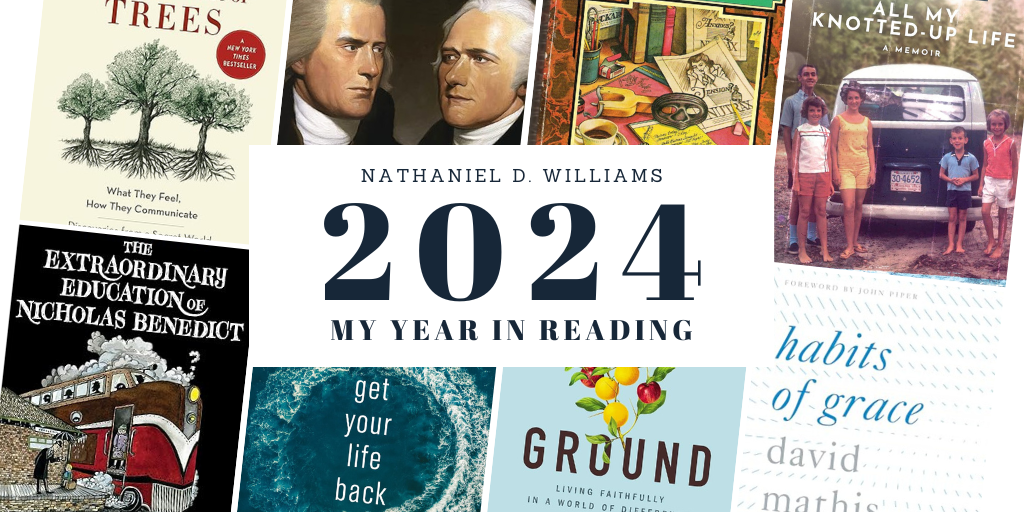

2024: A Year in Reading

Everyone has a different hobby. In the Williams family, we read books — and 2024 was no different. Some of my book trends remained similar to previous years (lots of kids books and Christian nonfiction), but some trends looked much different (fewer sports books, more leadership books.)

Either way, here’s a list of the books I read with a brief description. I share these in case any of these books sound interesting to you. But first, I want to highlight a few books I enjoyed most…

THE AWARDS

Nathaniel’s Book of the Year

The Hidden Life of Trees: What They Feel, How They Communicate―Discoveries from A Secret World
by Peter Wohlleben (Greystone Books, 2016)

I first heard of this book from Dr. Chuck Lawless at Southeastern Seminary. It didn’t sound like one I’d particularly enjoy, but I gave it a shot. And let me tell you — it was simply wonderful. Wohlleben takes us inside the world of trees — from their strategies to strengthen themselves, to the underground fungal network which helps them communicate with each other, to the wonder of ancient forests and the biological diversity they hold within. And, surprisingly, leadership lessons and applications jump from the page. In many ways, local churches are like a forest — in that trees are better together than they are apart. I can’t recommend this book highly enough.

Biggest Surprise

Get Your Life Back: Everyday Practices for a World Gone Mad
by John Eldredge (Thomas Nelson, 2020)

Cards on the table: I don’t agree with everything Eldredge writes. That hold true for this book. But if you can eat the meat and spit the bones, Get Your Life Back is a wonderfully helpful little book on pushing back against our anxiety-inducing busy world. The book’s strength is in identifying simple practices that, when implemented into the rhythms of your life, can create long-term change. “The world doesn’t budget time for soul care,” Eldredge writes. “You’re going to have to be intentional about this.” And this book was a major step for doing so in my own life.

The Book with the Best Chapter I Read This Year

Uncommon Ground: Living Faithfully in a World of Difference
by Tim Keller and John Inazu (Thomas Nelson, 2020)

Uncommon Ground is a collection of essays from various artists and thinkers, from Tish Harrison Warren and Lecrae to Kristin Deede Johnson and Trillia Newbwell. The essays are of varying quality, but this book makes my superlative list because of a chapter from Warren Kinghorn. Kinghorn breaks down the gospel of achievement, the false gospel that asserts our value and worth come from what we do or contribute. He explains how he’s seen this in his own life, and reveals how the true gospel helps us fight this false gospel. The chapter was a balm to my soul in a very stressful time, and for that reason I elevated the whole book to my superlatives.

The Book I’ll Probably Give Out to Church Members

Habits of Grace: Enjoying Jesus Through the Spiritual Disciplines
by David Mathis (Crossway, 2016)

I read multiple books on spiritual disciplines over the years, and I assign Don Whitney’s book to my interns and (this year) our Wednesday night group. But I think Habits of Grace just might be my favorite of the bunch. Mathis organizes the disciplines into sensible categories so they feel less like a laundry list of things to do and more like the integration of faith into rhythms of everyday life. Mathis also writes with simplicity and an economy of words; there’s no empty verbosity here. When I teach the disciplines again, I believe Mathis’ book will be my go-to text.

THE REST OF THE 2024 READING LIST

Books I Read with my Kids

Mercy Watson Is Missing!
by Kate DiCamillo and Chris Van Dusen (Candlewick, 2023)

I usually don’t include books like Mercy Watson in the book list; I don’t keep track with all the picture books I read to the kids. But Mercy Watson Is Missing! is an actual chapter book, so I included it. If you enjoy Kate DiCamillo’s lovable quirky characters (I’m looking at you, Leroy Tinker), you’ll enjoy this book.

Mrs. Piggle-Wiggle’s Farm
by Betty MacDonald with Maurice Sendak (1954)

A classic book with multiple vignettes of Mrs. Piggle-Wiggle’s unorthodox ways of breaking children of their bad habits. Harmless book, but not one I’d read again.

Winnie-the-Pooh
by A. A. Milne (1926)

This small book is an absolute delight, and I make an excuse to read it every time one of our kids becomes a toddler. The book is filled with joy, humor, and sincerity.

The Extraordinary Education of Nicholas Benedict
by Trenton Lee Stewart (Little, Brown Books for Young Readers, 2013)

Our family loves the Benedict Society books, and this was the last one for us to read. This book was a prequel, telling us Benedict’s life as a child. Sometimes the Benedict Society books do meander, but this one did so less than some of the others. Overall, we loved this book and seeing young Benedict become someone who learns to trust and value others’ dignity.

Secrets at Sea
by Richard Peck (Puffin Books, 2012)

Have you ever wondered what mice did when you weren’t looking? And what secret society they might have on a cruise ship? And what might happen if you met the mouse queen? Me neither, but Richard Peck has! I loved Peck’s Grandma Dowdle books, so I was eager to read this one to the kids. It was fine; probably not one I’d read again, but I think everyone enjoyed it.

A Bear Called Paddington
by Michael Bond

Paddington, like Winnie-the-Pooh, is a book I read every few years when one of my kids gets to the age when they can enjoy it for the first time. I love Paddington’s earnestness in the midst of being a fish out of water. It’s a tale that reminds us to empathize with the refugee and that everyone (or, in this case, every bear) has dignity, worth, and value.

Fiction

Gilead
by Marilynne Robinson (Picador, 2004)

My all-time favorite novel was a perfect companion during my summer sabbatical. John Ames’ wise reflections on life, ministry, fatherhood, and more breathe life into my soul. This time through, I already knew the plot and its surprises, so my attention was on Marilynne Robinson’s poetic, literary words. Simply a delight.

The Hobbit narrated by Andy Serkis
by J.R.R. Tolkien

I have a confession: I’ve never been able to get into The Lord of the Rings. I’m sure this makes me a bad Christian somehow, but it’s true. But this audiobook features Andy Serkis reading the book, and I enjoyed the experience. There are still parts of the book I don’t think I’ll ever enjoy (I’m looking at you, songs), but I’m glad I experienced it.

The Adventures of Sherlock Holmes
by Arthur Conan Doyle (1892)

This collection of 12 stories introduces us to Doyle’s infamous character, Sherlock Holmes. I enjoyed diving into this classic piece of fiction, especially since we’re all so familiar with the various versions of his character in pop culture. Some of the stories are better than others, but I enjoyed this introduction to the world of Sherlock Holmes.

The Return of Sherlock Holmes (Sherlock Holmes, #6)
by Arthur Conan Doyle (1905)

Another collection of stories about Sherlock Holmes from later in his career. The one that most sticks out is “The Story of the Dancing Men,” a haunting tale that feels like it could be the plot of an M. Night Shyamalan film. That story in particular keeps you on your toes the whole time.

The Case of the Missing Marquess (Enola Holmes #1)
by Nancy Springer (Penguin Young Readers Group, 2007)

After watch the Netflix Enola Holmes films, I wanted to read the first novel for myself. And, oddly enough, I liked the movie far better! The book is fine, but it just seems to end. And the changes the filmmakers made make the story feel more grand. So, feel free to read the book. But, in this case, you could also just watch the movie.

Murder Must Advertise (Lord Peter Wimsey #8)
by Dorothy L. Sayers (1933)

I’ve heard a lot about Dorothy Sayers’ Lord Peter Wimsey detective novels, so I wanted to give them a try. This one kept me on my toes, but there were certainly sections that lagged. Also, there were a ton of characters to keep up with. But I do see the appeal of these stories, as the Wimsey character is such a fun, playful character.

The Greatest Gift: A Christmas Tale
by Philip Van Doren Stern

This short story inspired the classic film, It’s a Wonderful Life! The story is short and sweet, and the movie improves the story in countless ways. But the protagonist’s personal dilemma remains the same: Does my life really matter? The story couldn’t find a publisher at first, but I’m sure glad that it has survived.

The Best Christmas Pageant Ever
by Barbara Robinson (1972)

In honor of the new film adaptation, I re-read this classic Christmas novel. It was simply a delight. Imogene Herdman’s dawning realization of the Christmas story really does allow us to understand the magnitude what happened when Christ was born.

Batman Begins: The Junior Novel
by Peter Lerangis (Scholastic, 2005)

I found this book in a stack of old books from my childhood, so I picked it up and read it. Let’s just say: You should stick to the movie.

Christian Nonfiction

The Read-Aloud Family: Making Meaningful and Lasting Connections with Your Kids
by Sarah Mackenzie (Zondervan, 2018)

I began 2024 with this book about the importance of reading aloud to your children. I found the book encouraging and affirming, as reading aloud is one of my favorite parts of the day.

Do Not Be True to Yourself: Countercultural Advice for the Rest of Your Life
by Kevin DeYoung (Crossway, 2023)

Kevin DeYoung adapts a graduation speech into this brief book. DeYoung offers wise advice that pushes back against popular themes in pop culture. The book is the perfect book to give to graduates.

God (Volume 1) (Theology for Every Person)
by Malcolm Yarnell III (B&H, 2024)

Dr. Malcolm Yarnell is an esteemed theologian in the Southern Baptist Convention, and he writes this brief, accessible book on the doctrine of God.

Spiritual Disciplines for the Christian Life
by Donald Whitney (NavPress, 1991)

Whitney’s classic book on spiritual disciplines is a staple in my interns’ reading, and this year we started reading it together as a church. The book is a helpful introduction to spiritual disciplines — with lots of excellent quotes and tips.

The Trellis and the Vine: The Ministry Mind-Shift that Changes Everything
by Colin Marshall and Tony Payne (Matthias Media, 2009)

How is the church an organism (as opposed to merely an organization)? How should this truth change how we think about church structures? This book is another staple in my interns’ reading, and I returned to it again in 2024.

The Rare Jewel of Christian Contentment: Abridged and in Modern English
by Jeremiah Burroughs (abridged by Rob Summers)

In the busyness and storms of life, contentment is a challenge. But this timeless book from Jeremiah Burroughs offers biblical wisdom (and challenges) to pursue contentment in our lives. I’m grateful for my church members who kindly loaned it to me.

Liturgy of the Ordinary: Sacred Practices in Everyday Life
By Tish Harrison Warren (IVP, 2016)

One of my favorite books of all time, and I re-read it every few years. Warren reminds us of the beauty and dignity of the ordinary parts of life, and she encourages us to see how God forms us through them.

Deep Discipleship: How the Church Can Make Whole Disciples of Jesus
by J. T. English (B&H, 2022)

This has become another go-to read, especially for my interns. English helps us see how to build structures to facilitate discipleship in local churches. As I often say, The Trellis and the Vine diagnoses the problems of most church structures, but Deep Discipleship offers a constructive solution.

Christ and the Common Life: Political Theology and the Case for Democracy
by Luke Bretherton (Eerdmans, 2019)

Bretherton offers a fresh perspective on the integration of faith and the public square. I don’t agree with Bretherton on every point, and as a British protestant who now works at Duke, he certainly approaches these topics from a unique perspective. But I think his perspective is worth hearing. (Note: this book is long and academic, so it’s not for everyone.)

Practice Resurrection: A Conversation on Growing Up in Christ
by Eugene H. Peterson (Eerdmans, 2010)

Peterson is one of my favorite authors. This book offered his reflections on Ephesians, and it was one of my go-to companions while preaching that book. Sometimes Peterson veers into speculation, but sometimes he’s spot-on. Either way, he’s a voice to be heard.

Parenting: 14 Gospel Principles That Can Radically Change Your Family
by Paul David Tripp (Crossway, 2016)

This book was one of my sabbatical reads, as I wanted to grow as a father. Tripp’s insights were timely and pointed for my life. While he doesn’t tell you what to do, he does offer a framework from which to parent.

Just Show Up: How Small Acts of Faithfulness Change Everything (A Guide for Exhausted Christians)
by Drew Dyck (Moody, 2023)

A short, encouraging book for Christians who feel tired, worn out, and unworthy. Dyck laces each page with self-deprecating humor, and he encourages us to (as the title indicates) just show up.

Anxious for Nothing
by Max Lucado (Thomas Nelson, 2017)

Max Lucado offers a brief but encouraging look at anxiety from a biblical perspective. Don’t expect an in-depth counseling book; this is a highly pastoral work aimed at everyday believers who struggle with anxiety.

Forgotten God: Reversing Our Tragic Neglect of the Holy Spirit
by Francis Chan (David C. Cook, 2009)

Francis Chan explores the identity and functions of the Holy Spirit, the person of the Trinity we tend to most overlook. The book is at its best when it surveys scripture and highlights scripture’s teachings on the Spirit. You can also tell that this book is in some respects a product of its time, as I can tell some of what Chan is writing is in response to theological and ecclesial debates of the time.

Shepherds for Sale: How Evangelical Leaders Traded the Truth for a Leftist Agenda
by Megan Basham (Harper Collins, 2024)

Journalist Megan Basham highlights the purported negative influence left-leaning outside money on evangelical institutions and the Southern Baptist Convention. The final chapter was deeply personal, and at that point I understood why these issues matter so much to Basham. I think the entire book would have been better — and more persuasive — if she wrote from that lens.

Prayerful: How the Scriptures, History, and Experience Can Shape Our Prayers
by Todd Von Helms (Truth Matters Press, 2024)

Todd Von Helms is a gifted apologist. This book is a simple introduction to prayer with bite-sized chapters.

Leadership

Make the Most of Your Productivity: A Guide to Honoring God with Your Time
by Ana Ávila (Crossway, 2024)

I read this book in anticipation for a podcast conversation with Ana. I found it interesting that this book was originally written in Spanish, and only this year translated to English. The book offers wise tips on stewarding our time well and maximizing productivity in a God-honoring way.

Supercommunicators: How to Unlock the Secret Language of Connection
by Charles Duhigg (2024)

Duhigg offers wisdom on how to communicate effectively in all settings. He encourages us to know what conversations are really about, to pay attention to what kinds of conversations are happening, to share goals in conversations, to ask about feelings, and to explore if identities are important to the conversation. The latter part of the book dives into some left-leaning talk of identity, but you can sift through that.

Chess Not Checkers: Elevate Your Leadership Game
by Mark Miller (Berrett-Koehler, 2015)

Chess Not Checkers is one of those leadership books that crafts a fictional story (a parable of sorts) to convey leadership lessons. Despite how corny the fictional story was, I found the lessons to be wise: Bet on leadership, act as one, win the heart, and excel at execution. His discussion of the need to build on systems not personality or to communicate the score visually were actually quite helpful.

The Art of Caring Leadership: How Leading with Heart Uplifts Teams and Organizations
by Heather R. Younger (Berrett-Koehler Publishers, 2021)

Younger urges leaders to care not just for the task at hand, but also for the people they oversee or serve. As a Christian (and especially as a pastor), her thoughts weren’t novel in the least bit. What she describes ought to characterize all believers. Again, towards the end, she too veers into left-leaning conversations about identity and such, but you can tell she’s operating with a leadership framework that has been influenced by faith.

The Energy Bus: 10 Rules to Fuel Your Life, Work, and Team with Positive Energy
by Jon Gordon (Wiley, 2007)

The Energy Bus is another one of those leadership books which conveys its points via a fictional story. Personally, I found the fictional story so outlandish and unrealistic (an all-knowing leadership guru of a bus driver) that I found it hard pay attention to the main points. The points are all quite helpful if you can get beyond the story.

History and Memoir

Jefferson and Hamilton: The Rivalry That Forged a Nation
by John Ferling (Bloomsbury Press, 2013)

The American Revolution is my favorite part of American history, and I read a book or two each year about it. This book tells the story of the Revolution through the lens of Jefferson and Hamilton’s rivalry. It’s hard not to compare this work with the musical Hamilton; while the latter clearly casts Hamilton as an early progressive, Ferling does the exact opposite. (It’s worth noting Ferling’s book was published a decade prior.) I’m reminded how much our current political moment influences our reading of history, often to our detriment.

Beyond the Wand: The Magic and Mayhem of Growing Up a Wizard
by Tom Felton (Grand Central Publishing, 2022)

Tom Felton played Draco Malfoy in the Harry Potter movie series. This book is his memoir of his life, experiences in the wizarding world, and his life since then. Felton is rather candid about his flaws and failures (of which there are many), but I walked away from the book feeling sorry for Felton. It seems like there’s an emptiness or lack of fulfillment in his life, and I don’t think he’ll find it apart from Jesus.

All My Knotted-Up Life: A Memoir
by Beth Moore (Tyndale, 2023)

Beth Moore tells the story of her life, with all the challenges, mistakes, pains, and wounds. Moore is surprisingly vulnerable in these pages, and I walked away with tremendous empathy for her life and experiences. Her writing is also a joy to read — you feel like you’re talking to her over a cup of sweet tea. Even if you don’t agree with all of Beth Moore’s writings, I think you’ll walk away moved by this story.

The Bomber Mafia: A Dream, a Temptation, and the Longest Night of the Second World War
by Malcolm Gladwell (Little, Brown and Company, 2021)

Malcolm Gladwell is so gifted at telling history in a way that readers can track with, and this book is no different. The story tells us about two competing ideologies for World War II bombing strategies, and which ideology won out in the war — but which one won out in history. What’s so special about this book is that it was crafted first as an audiobook and then adapted to a physical book. So the audiobook sounds like really well produced podcast. It’s worth a listen!

Commentaries

In 2024 I preached through Ephesians. Here are the commentaries I used:

  • Ephesians (New Covenant Commentary) by Lynn H. Cohick (Lutterworth Press, 2013)
  • Ephesians: A Theological Commentary for Preachers by Abraham Kuruvilla (Cascade Books, 2015)
  • Ephesians (Evangelical Exegetical Commentary) by SM Baugh (Lexham Press, 2016)
  • Ephesians: An Exegetical Commentary by Harold W. Hoehner (Baker, 2002)